A review
...of almost everything
Vectors
| Pythagorus | $$ a^2 + b^2 = c^2$$ | |
| Trig |
$\sin$, $\cos$, $\tan$,
$\sin^{-1}$, $\cos^{-1}$, $\tan^{-1}$ |
Needed to get the components or find resultants |
Unit Vectors

A unit vector is a vector that has a magnitude of exactly 1, and points in a given direction.
If $\mathbf{\hat{i}}$ points behind you, and $\mathbf{\hat{j}}$ points straight up, then which way should $\mathbf{\hat{k}}$ point?
- up
- down
- left
- right
- forward
- backward
Dots and Crosses
| Dot Product | $$\mathbf{a} \cdot \mathbf{b} = a b \cos \theta$$ | $\mathbf{a} \cdot \mathbf{b} = (a_x \hat{\mathbf{i}}+a_y \hat{\mathbf{j}}+a_z \hat{\mathbf{k}})\cdot(b_x \hat{\mathbf{i}}+b_y \hat{\mathbf{j}}+b_z \hat{\mathbf{k}}) $ |
| $\mathbf{a} \cdot \mathbf{b} = a_x b_x + a_y b_y + a_z b_z$ | ||
| Cross Product | $|\mathbf{a} \times \mathbf{b}| = a b \sin \phi$ | $\mathbf{a} \times \mathbf{b} = (a_x \hat{\mathbf{i}}+a_y \hat{\mathbf{j}}+a_z \hat{\mathbf{k}})\times(b_x \hat{\mathbf{i}}+b_y \hat{\mathbf{j}}+b_z \hat{\mathbf{k}}) $ |
| $\mathbf{a\times b} = \begin{vmatrix} \mathbf{i} & \mathbf{j} & \mathbf{k} \\ a_x & a_y & a_z\\ b_x & b_y & b_z\\ \end{vmatrix}$ |
If you want the cross product of $\mathbf{A}$ and $\mathbf{B}$ to be as large as possible, you should orient the vectors:
- Perpendicular to each other
- Parallel to each other
- 180 degrees to each other
- 45 degrees to each other
Kinematics
The way things move.
| Displacement | $$\mathbf{x}$$ |
| Velocity | $$ \mathbf{v} = \frac{d\mathbf{x}}{dt}$$ |
| Acceleration | $$\mathbf{a} = \frac{d\mathbf{v}}{dt} = \frac{d^2\mathbf{x}}{dt^2}$$ |
True or false:
"If the slope of an object's velocity vs. time curve is zero, then the object must be at rest"
- True
- False
True or false:
"The area under a velocity vs. time curve will tell you how far an object has traveled."
- True
- True, but only for constant acceleration
- False
Kinematic Equations
| Velocity | $$\mathbf{v} = \mathbf{v}_0 + \mathbf{a}t$$ |
| Displacement | $$\mathbf{x} = \mathbf{\bar{v}} t = \frac{\mathbf{v} + \mathbf{v}_0}{2}t$$ |
| Displacement | $$\mathbf{x} = \mathbf{x}_0+ \mathbf{v}_0 t + \frac{1}{2} \mathbf{a} t^2$$ |
| Speed | $$v^2 = v_0^2 + 2a \Delta x$$ |
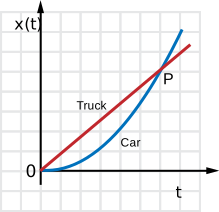
The x position vs time for a car and truck, both traveling on a straight track, is shown. What happens at point P?
- The two vehicles have the same velocity.
- The car passes the truck.
- The truck passes the car.
- They both stop accelerating.
2-D kinematics
Motions happen in 2 dimensions. Treat these dimensions separately.
| x-Displacement | $$\mathbf{x} = \mathbf{x}_0+ \mathbf{v}_{x0} t + \frac{1}{2} \mathbf{a_x} t^2$$ |
| y-Displacement | $$\mathbf{y} = \mathbf{y}_0+ \mathbf{v}_{y0} t + \frac{1}{2} \mathbf{a_y} t^2$$ |
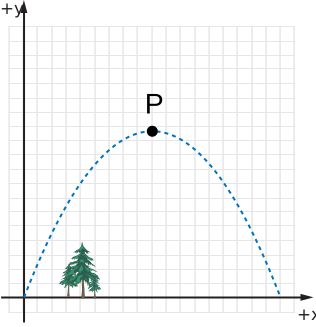
An object is launched across a field and travels as a projectile. At the point $P$, the acceleration of the object is:
- Smaller than everywhere else along the trajectory.
- zero - it's not accelerating anywhere along the trajectory.
- Pointed down and equal to 9.8 meters per second.
- zero - but only for an instant, then it will start increasing.
What angle of launch will maximize a projectile's range? (Assume no air resistance)
- Around 1 or two degrees.
- 15 degrees.
- 45 degrees.
- 60 degrees
Forces
Newtons' Three Laws
$\sum \mathbf{F} = m \mathbf{a}$
You're driving up a hill at a constant speed of 45 mph. Summing all the forces acting on your car will yield:
- A net force down (i.e. straight down)
- A net force up (i.e. towards the sky)
- A net force equal to zero
- A net force pointed up the the hill
- A net force pointed down the hill
The same force is applied to two different carts on the air track - Cart 2 has a mass three times greater than Cart 1. After some amount of time, how will the velocities of the carts compare?
- Cart 2 will be going 3 times faster
- Cart 1 will be going 3 times faster
- Cart 2 will be going 9 times faster
- Cart 1 will be going 9 times faster
- They will be going the same speed
Catalog of Forces
| Pushing/pulling | General, non-descript interactions |
| Tension | Forces applied using ropes. |
| Gravity | Attractive force between all objects with mass |
| Normal | Interaction force - points perpendicular to plane of contact |
| Friction | A model to explain how surfaces interact |
| Drag | Velocity Dependent air resistance |
| Springs | Hooke's Law |
| Buoyancy Force | "The weight of the fluid displaced" |
Gravity
| Newton's Law of Gravitation | $$\mathbf{F}_G = -\frac{G m_1 m_2}{r^2}\mathbf{\hat{r}}$$ |
| little g | $$g = \frac{G m_E}{R_E^2}$$ |
| weight (near surface of the earth) | $$\mathbf{F}_G = -mg\mathbf{\hat{j}}$$ |
An apple of mass $m_{apple}$ feels a force of attraction to the earth equal to $m_{apple} g$. What force does the earth feel due to the presence of this apple.
- $m_{apple} g$
- $m_{Earth} g$
- $0$
- Not enough information.
Friction
| static friction max | $$f_s^\textrm{max} = \mu_s F_N$$ |
| kinetic friction | $$f_k = \mu_k F_N$$ |
What are the units of $\mu_s$?
- Newtons (same as force)
- $m/s^2$
- kg
- 1/Newtons
- No units
True of False:
Kinetic friction force increases linearly with the velocity of the sliding object
- True
- False
Springs
| Hooke's Law / Restoring Force | $$\mathbf{F}_{spring} = - k \mathbf{x}$$ |
Circular Motion
| centripetal acceleration | $$a_c = \frac{v^2}{r}$$ |
| period / speed | $$v = \frac{2 \pi r}{T}$$ |
For an object traveling in uniform circular motion at constant speed, its velocity and acceleration vectors point:
- Both point inward, towards the center of the circle
- vel: inward / accel: outward, away from the center
- vel: tangential / accel: inward, towards the center
- vel: outward / accel: tangential
- vel: tangential / accel: outward, away from the center
Work & Energy
| Work | Non-constant Force | Constant Force |
| $$W = \int \mathbf{F}\cdot d\mathbf{x}$$ | $$W = \mathbf{F} \cdot \mathbf{d}$$ | |
| kinetic energy | $$KE = \frac{1}{2}mv^2$$ | |
| gravitational potential energy | $$PE = m g h$$ | |
| conservation of energy | $$W_\textrm{NC} = E_f - E_i$$ | |
| Force and Potential | $$\Delta U = -\int_{x_i}^{x_f} F(x)\;dx$$ | $$F = -\frac{dU}{dx}$$ |
If you do negative work on a particle, which of the following must be true?
- The particle is moving in the negative direction
- Your force is directed in the negative direction
- Both the particle's velocity and the force are pointed in the negative direction
- The particle's kinetic energy will decrease
Power
Power: change in energy per time
| Find the rate of energy change | $$P = \frac{dE}{dt}$$ |
Impluse
| Impulse | Non-constant Force | Constant Force |
| $$\mathbf{J} = \int_{t_i}^{t_f} \mathbf{F}(t) \; dt$$ | $$\mathbf{J} = \mathbf{F} \Delta t$$ | |
| momentum | $$\mathbf{p} = m \mathbf{v}$$ | |
| impulse-momentum | $$\mathbf{J} = \Delta \mathbf{p}$$ | |
|
And, momentum is always conserved. |
$$\mathbf{F} = \frac{d\mathbf{p}}{dt}$$ |
Rotational Kinematics
| Arc length | $$ r\theta = s$$ |
| angular displacement | $$\theta = \theta_0 + \omega_0 t + \frac{1}{2}\alpha t^2$$ |
| angular velocity | $$\overline{\omega} = \frac{\Delta \theta}{\Delta t}$$ |
| angular velocity | $$\omega^2 = \omega_0^2 + 2\alpha \theta$$ |
| $\boldsymbol{\omega}$ is a vector |
R.H.R. 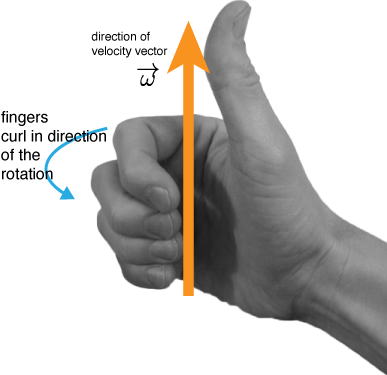
|
The angular velocity of the earth about its own axis points in the direction:
- From the center of the earth to the north pole
- From the center of the earth to the south pole
- Eastward (from NY towards the Atlantic)
- Westward (from NY towards NJ)
- The earth has no angular velocity: $\omega = 0$.
The angular acceleration of the earth about its own axis points in the direction:
- From the center of the earth to the north pole
- From the center of the earth to the south pole
- Eastward (from NY towards the Atlantic)
- Westward (from NY towards NJ)
- The earth has no angular acceleration: $\alpha = 0$.
Rotational Dynamics
| Torque | $$\tau = \mathbf{r} \times \mathbf{F}$$ | $$\tau = r F \sin \phi$$ |
| Moment of Inertia | $$I_\textrm{point-mass} = m r^2$$ | $$I_\textrm{parallel axis} = I_\textrm{C.o.M} + mh^2$$ |
| Rotational 2nd law | $$\boldsymbol{\tau} = I \boldsymbol{\alpha}$$ | |
| Kinetic energy of rotation | $$KE_\textrm{Rot} = \frac{1}{2}I \omega^2$$ | |
|
And, angular momentum is always conserved. |
$$\mathbf{L} = I \boldsymbol{\omega}$$ | $$\boldsymbol{\tau} = \frac{d\mathbf{L}}{dt}$$ |
An object is rotating. If both its moment of inertia $I$ and its angular velocity $\omega$ are doubled, what will happen to the rotational kinetic energy?
- Decreases by a factor of 8
- Decreases by a factor of 4
- Decreases by a factor of 2
- Stays the same
- Increases by a factor of 2
- Increases by a factor of 4
- Increases by a factor of 8
Oscillations
| General Restoring Force | $$\mathbf{a} = \frac{d^2\mathbf{x}}{dt} = \ddot{\mathbf{x}} = -\cal{O} \mathbf{x}$$ | Solution: $x(t) = A \cos (\omega t + \phi)$ |
| Mass on a spring | $$\omega = 2 \pi f = \frac{2 \pi}{T} = \sqrt{\frac{k}{m}}$$ | |
| Potential Energy | $$U_\textrm{sp} = \frac{1}{2}k x^2$$ | |
| Physical Pendulum | $$T = 2 \pi \sqrt{ \frac{I}{mgL}}$$ | |
| Simple Pendulum | $$T = 2 \pi \sqrt{ \frac{L}{g}}$$ |

Two identical spring/mass systems are shown. Both springs have the same $k$, and the masses are equal. The only difference is one is oriented vertically with respect to gravity, the other is horizontal. How will their frequencies of oscillations compare?
- System A will oscillate faster ($f_A > f_B$)
- System B will oscillate faster ($f_B > f_A$)
- The will have the same oscillation frequency ($f_A = f_B$)
On a regular swing set at the playground, and adult (big $m$) and a child (small $m$) are both swinging on the swings. Can they swing with the same frequency?
- No
- Yes, as long as the lengths of the chains holding the swings are different
- Yes, as long as the lengths of the chains holding the swings are the same
Simple Harmonic Motion
| Position | $$x(t) = A \cos (\omega t)$$ |
| Velocity | $$v(t) = - A \omega \sin (\omega t)$$ |
| Acceleration | $$a(t) = - A \omega^2 \cos (\omega t)$$ |
| Damping | $$x(t) = e^{-t/\tau} A \cos (\omega t + \phi)$$ |
Fluids
| density | $$\rho = \frac{m}{V}$$ |
| Pressure | $$P = \frac{F}{A}$$ |
| Change in pressure due to depth | $$P_2 = P_1 + \rho g h$$ |
| Archimedes' Principle. | $$F_B = W_\textrm{fluid}$$ |
How will the lifting force caused by buoyancy on a ballon depend on its height above the ground?
- It will get weaker the higher up the balloon is
- It won't change at all even if the balloon reaches very high altitudes
- It will get stronger the higher up the balloon is
Moving Fluids
| Continuity | $$ \rho_1 A_1 v_1 = \rho_2 A_2 v_2$$ |
| Bernoulli | $$P_1 + \frac{1}{2} \rho v_1^2 + \rho g y_1 = P_2 + \frac{1}{2} \rho v_2^2 + \rho g y_2 $$ |
Temperature and Heat
| Thermal Contraction | $$\Delta L = \alpha L_0 \Delta T$$ |
| Specific Heat | $$Q = cm \Delta T$$ |
| Phase changes | $$Q = mL_F \; \textrm{or} \; mL_V$$ |
| Thermal Conductivity | $$Q = \frac{ k A \Delta T \; t }{L}$$ |