Superposition of Waves
What happens when two waves touch.
Principle of Superposition
When two marbles collide, they bounce back. That's how material objects behave. Two different objects can't occupy the same space at the same time.
Waves, on the other hand, can occupy the same space. These two wave pulses are moving towards each other, then start to overlap, then continue on.
Principle of Superposition
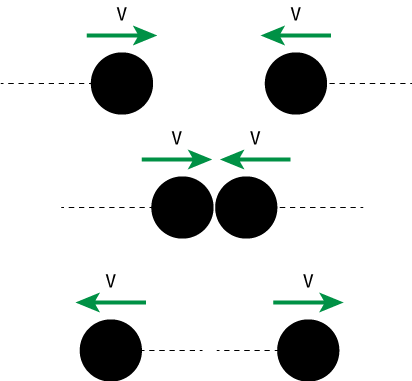

This is one of the major concepts of physics - superposition.
What ever the two waves are, all we need to do is add them up in order to find the new wave.
$y'(x,t) = y_1(x,t) + y_2(x,t)$
These two waves are approaching each other at t=0. What will the sum look like at t = 2 s?

Math of Superposition
Let's add two waves traveling in the same direction on the same string.
($k$, $\omega$, and $A$ are the same)
wave 1: $y_1(x,t) = A \sin(kx - \omega t)$
wave 2: $y_2(x,t) = A \sin(kx - \omega t + \phi)$
Since, $$ \begin{eqnarray} y'(x,t) & = & y_1(x,t) + y_2(x,t)\\ & = & A \sin(kx - \omega t) + A \sin(kx - \omega t+ \phi) \end{eqnarray} $$
with a trig identity (below) $$y'(x,t) = [2 A \cos \frac{\phi}{2} ]\sin (kx - \omega t + \frac{\phi}{2})$$
This is a very useful trig identity:
$$\sin \alpha + \sin \beta = 2 \sin \frac{1}{2} (\alpha + \beta) \cos\frac{1}{2}(\alpha - \beta)$$The sum of two waves
These two waves (the red and the blue) are added together to get the purple wave.
Red curve:
wave 1: $y_1(x,t) = A \sin(kx - \omega t)$
Blue curve:
wave 2: $y_2(x,t) = A \sin(kx - \omega t + \phi)$
Purple Curve:
$y'(x,t) = [2 A \cos \frac{\phi}{2} ]\sin (kx - \omega t + \frac{\phi}{2})$
Summary of interference types
Interference is used to describe this phenomenon.
| Phase difference in | Amplitude | Interference Type | ||
| Degrees | Radians | wavelength | ||
| 0º | 0 | 0 | $2A$ | Fully Constructive |
| 120º | $\frac{2\pi}{3}$ | .33 | $A$ | Intermediate |
| 180º | $\pi$ | .5 | 0 | Fully destructive |
| 240º | $\frac{4\pi}{3}$ | .67 | $A$ | Intermediate |
| 360º | $2 \pi$ | 1 | $2A$ | Fully Constructive |
(Applicable for waves with the same amplitude and wavelength traveling in the same direction.)
Waves traveling in opposite directions.
Here are two waves with equal amplitudes and frequencies traveling in opposite directions on a string. (The blue wave is the sum of the two red waves)
Math of Superposition for opposite direction
Let's add two waves traveling in opposite direction on the same string.
($k$, $\omega$, and $A$ are the same)
wave 1: $y_1(x,t) = A \sin(kx - \omega t)$
wave 2: $y_2(x,t) = A \sin(kx + \omega t)$
Since, $$ \begin{eqnarray} y'(x,t) & = & y_1(x,t) + y_2(x,t)\\ & = & A \sin(kx - \omega t) + A \sin(kx + \omega t) \end{eqnarray} $$
with a trig indentity (below) $$y'(x,t) = [2 A \sin kx ]\cos (\omega t)$$
This is not of the standard traveling wave format! Indeed, this equation describes a standing wave.
Standing waves
For traveling waves, the amplitude of displacement of each element was the same. They would all get displaced to a maximum $A$. In a standing wave, the amplitudes will be position dependent.
$$y'(x,t) = [2 A \sin \underbrace{ (kx)}_{\textrm{position dependent}} ]\cos (\omega t)$$The $kx$ argument of the sine function leads to this phenomenon.
Nodes
Since $\sin (n \pi) = 0$, we can determine where exactly the amplitudes will be zero.
Whenever $kx = n\pi$, $n = 0,1,2,3...$, we'll obtain a zero for the displacement.
Rearranging: $$x = n\frac{\lambda}{2}$$.
Anti-Nodes
Likewise, when $\sin (kx)$ = 1, the rope will undergo a maximum displacement.
$$ \begin{eqnarray} kx & = & \frac{\pi}{2}, \frac{3\pi}{2}, \frac{5\pi}{2}, ... \\ & = & (n+\frac{1}{2})\pi \; \textrm{for} \; n = 0,1,2... \end{eqnarray} $$
Nodes and Antinodes
Here is our standing wave.
One node and one antinode are pointed out. (Although there are many more)
Boundary (hard)
If we send a wave pulse down a string, where the string is fixed at the far end, we see that the waveform flips.
Boundary (soft)
If we send a wave pulse down a string, where the string is loose at the far end, we see that the waveform does not flip.
Creation of a standing wave
Standing waves and resonance
If we oscillate a fixed string in such a way that there is a node at each end point, we have effectively set up a standing wave. This will happen when the frequency of oscillation is in resonance with the string characteristics.
Thus, only wavelengths which 'fit' in the string will create resonant oscillations.
These are called 'harmonic modes' (shown are 1, 2, and 3).

Resonance frequencies
What determines the resonance frequencies?
Remember that $v = \lambda f$. Now, the velocity of the wave wave given by the physical characteristics of the string: the linear mass density, $\mu$, and the tension, $\tau$.
Therefore we can write: $$f = \frac{v}{\lambda} = n\frac{v}{2L} = n \sqrt{\frac{\tau}{\mu}}\frac{1}{2L}$$
When a wire under tension oscillates in its third harmonic mode, how many wavelengths are observed?
- 1/3
- 2/3
- 1/2
- 3/2
- 2
Which of these could be the frequency of a standing wave with a wave speed of 12 m/s as it oscillates on a 4.0-m string fixed at both ends? (it might not be the lowest harmonic)
- 2.5 Hz
- 5.0 Hz
- 10 Hz
- 15 Hz
- 20 Hz
Example Problem: Piano String
The lowest note on most pianos is A 0. It has a frequency of 27.5 Hz. The vibrating section of this wire on a grand piano is 1.9 meters long. [1 meter of piano wire has a mass of 200 g ] What is the tension in the string?
Interference

Consider a speaker playing a pretty sinusoidal wave with a wavelength $\lambda$.
Then, another speaker playing the exact same pitch is placed in front of Speaker 1, so that the two speakers are exactly one wavelength apart.
The two signals, or waves, will constructively interfere creating a signal of larger amplitude.
Now, let’s imagine the second speaker was producing a wave exactly opposite to the speaker 1 wave.
The sum of these two waves will now be equal to zero, since they are always creating destructive interference.
These two waves are called “out of phase”.

Math of 1-D audio interference
If want to know what the sound is like at point A, we’ll need to know how far it is from both sources:

If $\Delta d$ is equal to wavelength times a whole number, then the amplitude of the oscillations is increased: $\Delta d = n \lambda$
If $\Delta d$ is equal to wavelength times half an integer number, then the amplitude of the oscillations is decreased: $\Delta d = \frac{n \lambda}{2}$
Two speakers
Math of 1d interference
The phase difference between two waves will determine whether the interference is constructive or destructive. For constructive: $$ \Delta \phi = 0,\; 2\pi, \;4\pi \ldots$$ and for destructive: $$ \Delta \phi = \pi, \; 3\pi, \; 5\pi \ldots$$
The equations of two traveling waves (traveling in the same direction with the same frequency and wavelength) are given by: $$y_1 = A \sin \left( kx_1 - \omega t + \phi_{10} \right)$$ and $$y_2 = A \sin \left( kx_2 - \omega t + \phi_{20} \right)$$
For these waves, $\phi_{10}$ means the intitial phase constant of wave 1.
Thus, the phases, or the arguments of the sine terms are given by: $$\phi_1 = kx_1 - \omega t + \phi_{10}$$ and $$\phi_2 = kx_2 - \omega t + \phi_{20}$$
If we subtract these two phases, that is find $\Delta \phi$ (aka the phase difference): $$\Delta \phi = \phi_2-\phi_1= k(x_2-x_1)+(\phi_{20}-\phi_{10}) = \frac{2\pi}{\lambda}(x_2-x_1)+\Delta \phi_0$$
And so, for the case of two sound sources in one dimension, if we want to figure out when constructive interference will occur, based on either the initial phase constants of the two waves, or the separation in space: $$\Delta \phi = \frac{2\pi}{\lambda}(x_2-x_1)+ \Delta \phi = 0,\; 2\pi, \;4\pi \ldots$$ Or for destructive interference: $$\Delta \phi = \frac{2\pi}{\lambda}(x_2-x_1)+ \Delta \phi = \pi,\; 3\pi, \;5\pi \ldots$$
1d-interference
Here is the phase difference equation: $$\Delta \phi = \frac{2\pi}{\lambda} (x_2-x_1) + \Delta \phi_0$$ We can see that there are two contributions:
-
The path-length difference, $ x_2 - x_1 $, in proportion to the wavelength.
-
The inherent phase difference between the two oscillators.
If we have two identical sources that are in phase (i.e. $\Delta \phi_0 = 0$), then only the path length difference will determine if the waves constructively or destructively interfere. $$\Delta x = m \lambda$$ where $m$ is an integer will create maximum constructive interference. This makes sense. If the waves are separated by a whole number of wavelengths, then it's essentially the same as if they are not separated at all.
Sounds waves in 2-dimensions (or 3)
Here is a single source. Imagine just one speaker, creating pressure waves in the air.
Now we add a second source.
Consider 2 points. We need to figure out how far they are from each sound source.

Constructive and Destructive Interference
We can find some general guidelines to determine if we'll have constructive or destructive interference based on the position of the listener.
- Case 1: The path length difference is equal to a whole number of wavelengths:
$$\Delta L = n \lambda$$ This yields constructive interference - Case 2: The path length difference is equal to a half number of wavelengths:
$$\Delta L = \left( n+\frac{1}{2}\right) \lambda$$ This yields destructive interference
Rephrased in terms of phase.

Mathematically speaking, interference is determined by the phase difference between two waves.
If $\phi$ is 0, $2\pi$, or any multiple of $2\pi$, constructive interference occurs
i.e. $ \phi = m \times 2\pi $ where $m = 0,1,2,\ldots$
This is contrary to destructive interference which occurs at odd multiples of $2\pi$
i.e. $ \phi = (2m + 1)\pi$ where $m = 0,1,2, \dots$

Here are two sound source emitting wound waves in phase. The solid lines are the maxiumum pressure regions, the dashed lines show the location of the minimum pressure regions, at $t = t_0$
At point 1, the interference is
- Maximum Constructive
- Constructive, but less than maximum
- Perfectly Destructive
- Destructive, but only partially
- No interference
At point 2, the interference is
- Maximum Constructive
- Constructive, but less than maximum
- Perfectly Destructive
- Destructive, but only partially
- No interference
At point 3, the interference is
- Maximum Constructive
- Constructive, but less than maximum
- Perfectly Destructive
- Destructive, but only partially
- No interference
Two speakers in a plane are 2.0 m apart and in phase with each other. Both emit 700 Hz Sound waves into a room where the speed of sound is 341 m/s. A listener stands 5.0 m in front of the speakers and 2.0 m to one side of the center. Describe the interference at this point in space.
Reflecting sound waves
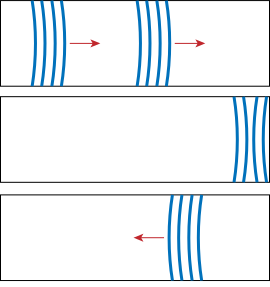
Just like with a wave on a string, if the conditions are right, we'll obtain a standing wave inside the tube.
Pressure and Displacement in tubes

Pressure and Displacement in tubes

Wind Instruments...
… are just tubes with air flowing. The length of the tube is one important aspect. Different notes are created by covering holes, which effectively change the length of the tube.

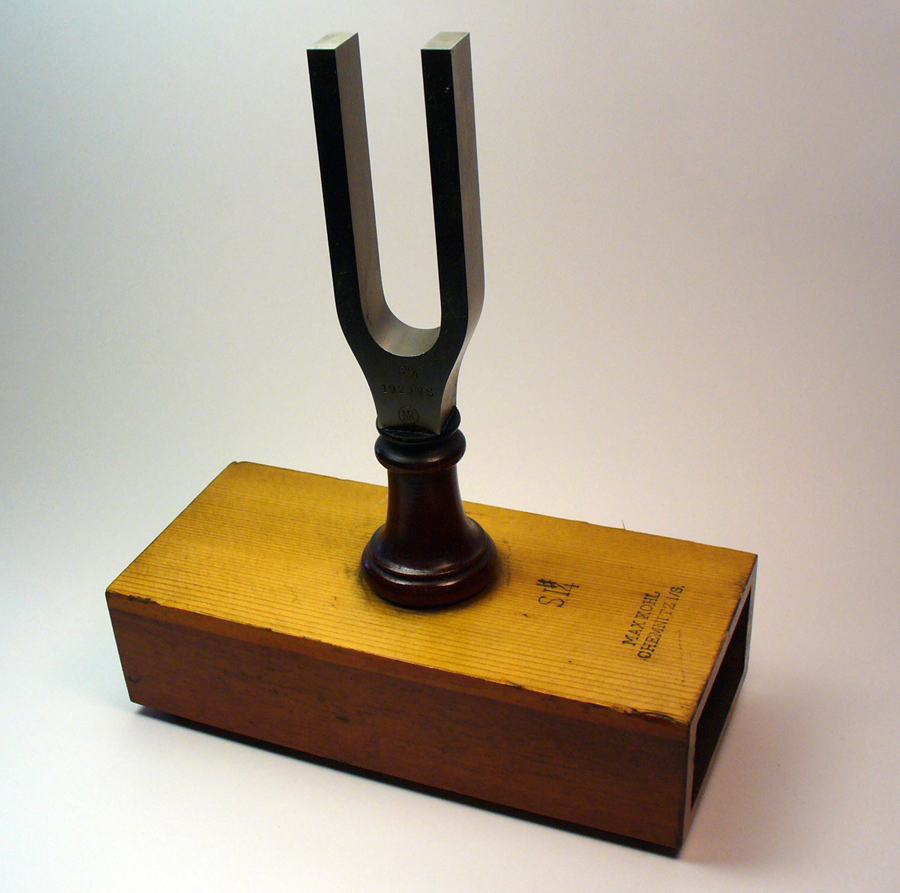
Tuning Forks
Tuning forks are very clean oscillators.
The ends (called tines) move back and forth in a very sinusoidal motion.
This motion creates the pressure waves that we hear as a pure sine wave.
The wavelength and thus the frequency are given by the geometry and materials of the tuning fork.


Here is a tuning fork
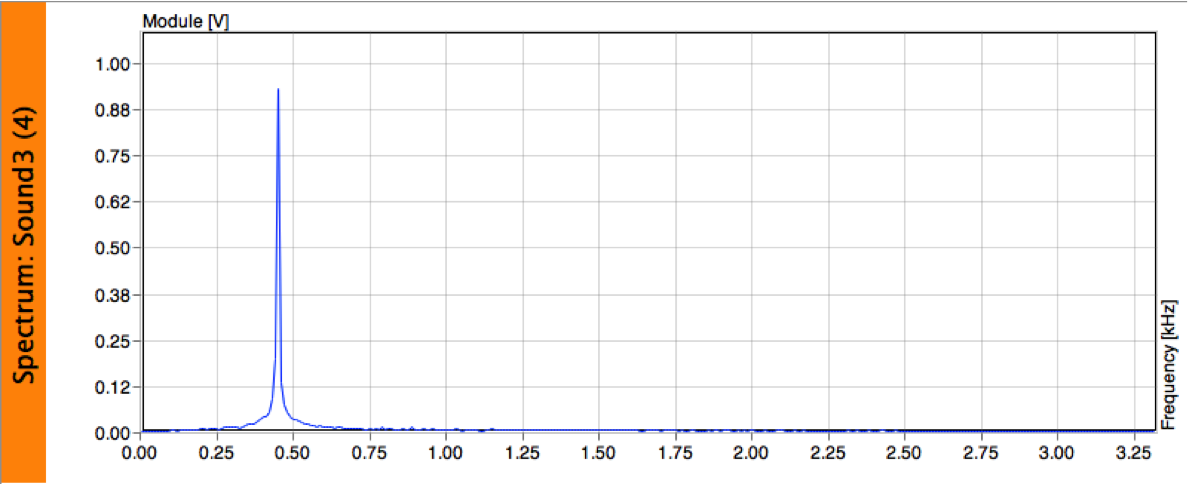
And here is the frequency spectrum of the sound the tuning fork makes. The spectrum is a graph of the signal strength verses frequency. We can see that one frequency has a very high value.
Sound, in general

Rarely do we hear perfect sinusoidal oscillations. Most instruments, noises, vocalizations are mixtures of many different oscillations.
This is middle C on the piano. You can see the fundamental at 261 Hertz. But there are a lot of higher tones also present. The zoom in shows even more little peaks.
Beats

So far, all this talk of interference has been about two sources with the same frequency. In real life, that’s usually not the case.
Here are two plots of sine waves coming from two speakers located at the same place.
The top sound has a frequency of 1 Hertz while the bottom has a frequency of 1.1 Hertz.
It’s hard to tell they are different.


Let each of the two source waves be given by:
$$ s_1 = s_m \cos \omega_1 t \;\;\textrm{and}\;\;s_2 = s_m \cos \omega_2 t $$The resultant displacement is then:
$$ \begin{equation} s = s_1+s_2 = s_m \left(\cos \omega_1 t+ \cos \omega_2 t\right) \end{equation} $$Using a trig identity, this becomes:
$$ \begin{equation} s = 2 s_m \cos \left[\frac{1}{2} \left(\omega_1-\omega_2\right)t\right] \cos \left[\frac{1}{2} \left(\omega_1+\omega_2\right)t\right] \end{equation} $$if $\omega' = \frac{1}{2}(\omega_1-\omega_2)$ and $\omega = \frac{1}{2}(\omega_1+\omega_2)$, then the above equation becomes more tidy:
$$s(t) = [2s_m \cos \omega' t]\cos \omega t$$
Since $\omega \gg \omega'$, the term in brackets can be considered a modulated envelope oscillating at angular frequency $\omega'$.
Its min and max values occur twice in a given cycle.
This oscillation between a min and max is what we hear as beats.
$$\omega_\textrm{beat} = 2\omega' = 2(\tfrac{1}{2})(\omega_1-\omega_2) = \omega_1-\omega_2$$or, in terms of frequency, $f$:
$$f_\textrm{beat} = f_1-f_2$$
| Mass (kg) | $f_3$ (Hz) |
|---|---|
| 2.00 | 68 |
| 4.00 | 97 |
| 6.00 | 117 |
| 8.00 | 135 |
| 10.00 | 152 |
A heavy mass is suspended from a 1.65 m long steel wire. (The wire has a mass of 5.85g) The frequencies of the 3rd harmonic oscillation of the wire as a function of mass are given below in the table. Use this data to determine a value of $g$.
Enter: Fit{{0,0},{2 , 68^2},{4 , 97^2},{6 , 117^2},{8 , 135^2},{10, 152^2}} at wolframalpha.